The purpose of this article is to show how the R package can be a suitable template for organising files into a research compendium to enhance the reproducibility of research.
Marwick, Boettiger, and Mullen, Packaging Data Analytical Work Reproducibly Using R (and Friends) (2018)
4.1 Learning objectives
By the end of this chapter the reader should be able to:
Explain what a research compendium is, and trace its lineage from Gentleman and Temple Lang through rrtools.
Justify why the R-package structure is the ideal compendium container, and describe how R CMD check thereby becomes a universal integrity gate.
Enumerate the Five Pillars of a compendium and name the single artifact that captures each.
Distinguish the five compendium archetypes and state, for each, how the directory layout, the presence of a rendered report, and the applicable validation gates differ while the reproducibility machinery stays the same.
Apply the principle of progressive disclosure to let a project evolve from one archetype to another without structural reorganisation.
4.2 Orientation
Consider a first-year epidemiology student who has spent three months on a cohort analysis: an incident-diabetes study drawn from a registry, with a cleaning script, a handful of models, four figures, and a draft of a results section. The work exists, but it exists as a scatter. The cleaning script sits in a downloads folder, the models in a second file that reads a spreadsheet whose path is hard-coded to one laptop, the figures as loose png files pasted by hand into a manuscript, and the record of which package versions produced any of it nowhere at all. Nothing here is wrong as statistics. The problem is that the analysis is not an object. It cannot be handed to a colleague, cited, archived, or re-run, because there is no single thing to hand over.
The remedy is to make the analysis one object. A research compendium is that object: a single, self-describing directory that bundles the code, the data, the prose, and the record of the environment in which the analysis was run, organised by convention so that another person, or the same person a year later, can find every part and regenerate the result. The compendium is the third of the recurring ideas of this book, after the levels ladder and the capture-versus-validate distinction, and it is the one that gives the other two something to act on. A reproducibility level is a property of a compendium; a validation gate is a check run against a compendium.
The compendium also sets the starting rung on the ladder. Merely by being a version-controlled directory whose parts can be located, a compendium reaches L0, locatable. It is not yet L1, because nothing has pinned the package versions; it is not yet L2, because nothing has pinned the environment; and it is certainly not yet L3, because nothing has re-run it and shown the numbers to match. What the compendium provides is the container into which the later chapters install those higher guarantees. We build the box first, and the chapters that follow fill it.
4.3 The analyst’s contribution
Three judgements at the centre of this chapter are the analyst’s alone. No tool scaffolds them, and getting them wrong produces a tidy directory that is nonetheless the wrong shape for the work.
Naming the archetype. The analyst must decide what kind of object the project is: a data analysis, a manuscript, a reusable package, a simulation study, or a blog. This choice governs the layout, whether a report is rendered, and which gates apply. It is a statement of intent, not a technical setting, and it is the organising decision of the chapter.
Fixing the raw-and-derived boundary. The analyst must decide what is an immutable input and what is a product of the analysis. A file placed in raw_data/ is a promise that it will never be modified; a file in derived_data/ is a promise that it can always be regenerated from the raw inputs and the code. No program can draw this line, because it depends on where the analyst judges the science to begin.
Deciding what becomes a function. The analyst must decide which code is a throwaway pipeline step, belonging in analysis/scripts/, and which is a reusable procedure worth documenting and testing, belonging in R/. This judgement determines what R CMD check and the test suite will actually protect, and it is revisited continuously as a project matures.
NoteThe vocabulary of this chapter
Research compendium: a single self-describing directory bundling the code, data, prose, and environment record of an analysis, organised by convention so that it can be located and re-run.
R-package skin: the minimal set of files (DESCRIPTION, NAMESPACE, an R/ directory) that makes a directory a valid R package, and therefore checkable by the R build tools.
R CMD check: the standard R command that builds a package, runs its tests, and applies dozens of standardised checks; here it serves as a universal integrity gate on the whole compendium.
The Five Pillars: the five artifacts a compendium manages, one per capture point: the Dockerfile, renv.lock, .Rprofile, the source code, and the data.
Archetype: the kind of research object a compendium is (data analysis, manuscript, package, simulation study, or blog), which varies the layout and the gates but not the underlying machinery.
Render gate: a validation check that a report or document rebuilds cleanly from source; it applies to archetypes that carry a report and not to those that do not.
Raw versus derived data: immutable original inputs versus the processed datasets regenerated from them by code.
Progressive disclosure: the property that one layout supports a project’s evolution from one archetype to another with no reorganisation.
4.4 The compendium as the unit of reproducible work
The idea is not new, and its history is worth a paragraph because it explains the shape of the modern object. Gentleman and Temple Lang, writing in 2007, proposed the compendium in its current sense: a document that combines text, code, and data in a form a reader can actually execute, rather than a paper that merely describes an analysis performed elsewhere (Gentleman & Temple Lang, 2007). The proposal drew on Knuth’s earlier notion of literate programming, in which prose and code are woven into one source (Knuth, 1984). For some years the compendium remained an aspiration without a conventional implementation, and Peng, arguing that reproducibility should be treated as a minimum standard for computational science, sharpened the motivation without settling the container (Peng, 2011).
The decisive move came from Marwick, Boettiger, and Mullen, who observed that a container of exactly the required shape already existed and was in daily use by thousands of R developers: the R package (Marwick et al., 2018). An R package, as standardised by Wickham (Wickham, 2015), already provides a DESCRIPTION file recording metadata and dependencies, an R/ directory for reusable functions, a tests/ directory for unit tests, a vignettes/ directory for long-form prose, and a rigorously specified build system. Marwick and colleagues extended this layout with a single top-level analysis/ directory holding subdirectories for raw data, derived data, scripts, figures, and the manuscript itself, and packaged the whole as the rrtools tool. The resulting compendium can be installed, tested, and checked with the very same commands used for any R package. Nust, Boettiger, and Marwick later wrote a companion guide on how to read such a compendium, which is a useful sign that the object had matured enough to have a reading protocol at all (Nüst et al., 2018).
4.5 The R package as the compendium container
The choice of the R package as the container is the single most consequential design decision in this lineage, and it repays careful statement. It appears at first to be a convenience, reuse of a familiar layout, but its real value is that it makes an existing, rigorous, and universal gate apply to the whole compendium for free.
The gate is R CMD check. When R was designed as a system for distributing statistical software, its authors built a command that takes a package and subjects it to dozens of standardised checks: that the code parses and loads, that every documented function matches its documentation, that declared dependencies are actually available, that the examples run, and that the tests pass. The command was built to keep the tens of thousands of packages on CRAN mutually consistent. By dressing a compendium in the R-package skin, one inherits this entire apparatus at no cost. A compendium that passes R CMD check is one whose code loads, whose stated dependencies resolve, and whose tests succeed, in a clean process that carries none of the author’s accumulated and undeclared state.
This is why the R-package structure is not incidental to the compendium but constitutive of it. Every archetype we shall meet below, however different in outward shape, carries the same minimal R-package skin, and therefore R CMD check is the one gate that applies to all of them. A manuscript compendium adds a render gate on top; a simulation compendium adds a seeding discipline; a package compendium leans on the check most heavily of all; but the universal floor is the same. We return to this point when we tabulate the archetypes, because it is the thread that unifies them.
NoteCheck your understanding: why an R package?
A colleague proposes to organise a compendium as a plain folder with sensible subdirectory names, arguing that the R-package files (DESCRIPTION, NAMESPACE) are empty ceremony for an analysis that is not a package anyone will install. What is lost by this choice?
The plain folder can still be locatable and can still hold all five artifacts, so it can in principle reach the higher levels of the ladder. What is lost is the universal gate. Without the R-package skin, R CMD check has nothing to check, so there is no single, standard, pre-built command that verifies the code loads, the dependencies resolve, and the tests pass. The analyst must then assemble an equivalent set of checks by hand for every project. The ceremony is precisely the interface that makes an existing verification apparatus apply.
4.6 The Five Pillars
A compendium is defined by convention, but it manages a specific and small set of artifacts. The zzcollab framework organises these as the Five Pillars: the five things a compendium reads, writes, and version-controls, one for each point at which reproducibility can be captured (Thomas, 2026). An analysis is reproducible only to the extent that all five are captured, and the pillars are layered rather than independent, each resting on the ones beneath it.
Computational environment, captured by the Dockerfile. This pillar fixes the operating system, the R version itself, the system libraries, and the document toolchain, all the software beneath the R packages. It is the subject of Chapter 6.
Package versions, captured by renv.lock. This pillar records the exact version of every R package the analysis loads, so that the same set can be restored on another machine. It is the subject of
Session configuration, captured by the project .Rprofile. This pillar fixes the R options, the random-number-generator kind, the locale and timezone, and the thread counts that shape a session before any user code runs.
Source code, captured by the version-control history. This pillar holds the scripts, the functions, the manuscript source, and the tests that implement the analysis.
Data, captured either by inclusion in the compendium, for small redistributable files, or by reference to an external repository with a resolvable identifier, for large or restricted data.
Two of the pillars are not coordinate with the other three. Source code and data, pillars four and five, are the inputs whose re-execution is the goal; the environment, packages, and session, pillars one through three, are the conditions under which that re-execution occurs. This chapter is about the container that holds all five and the shape that container takes. The individual pillars are developed in the chapters named against them.
ImportantThe honest level
Assembling the five artifacts into a tidy compendium is a capture activity, and it is easy to mistake the tidiness for a reproducibility guarantee. A compendium that contains a Dockerfile, a renv.lock, and a clean analysis/ tree looks reproducible, but until the image has been rebuilt from the recipe, the lockfile restored, and the outputs regenerated and compared, the compendium sits at L0 or L1, not at L2 or L3. Match the claim to the rung actually reached. A well-organised directory is a precondition for reproducibility, not evidence of it.
4.7 The directory layout, concretely
It helps to see the whole layout at once. The following is the top-level structure of a zzcollab compendium. The block is illustrative and is not executed.
The reader will note the division. Above the analysis/ directory sits the standard R-package machinery: this is the skin that makes R CMD check apply. Within analysis/ sits the research proper, in the Marwick convention, with the raw-and-derived data separation that is the analyst’s second judgement made physical. At the root sit the three environment artifacts, one per pillar, alongside the Makefile that provides the commands and the zzcollab.yaml that records, among a small set of parameters, the archetype. That last file is our bridge to the centrepiece of the chapter, because the archetype is a first-class parameter recorded there, elicited at creation time alongside the choice of base image.
4.8 The five archetypes
We come now to the heart of the matter, and to the point this book returns to in every chapter: a research compendium is not only a manuscript. It is tempting, once one has seen the analysis/report/ directory, to imagine that the purpose of a compendium is always to render a paper. This is the common case, but it is one case among five, and treating it as the whole is the error the present section exists to prevent.
zzcollab treats the research archetype as a first-class initialisation parameter, orthogonal to the choice of computational environment (Thomas, 2026). Where the base image fixes the environment, the archetype determines the starting scaffolding: the directory emphasis, whether a primary report exists, and which validation gates apply on top of the universal one. Five archetypes are advertised, and because every one of them carries the minimal R-package skin, R CMD check remains the universal gate across all five, as the framework’s own whitepaper stresses in its account of the archetype axis. What varies is not the reproducibility machinery, which is identical, but the shape of the work and the gates it warrants. We take each in turn, with a health-sciences example, and then tabulate the differences.
4.8.1 1. Data analysis (a cohort study)
The first archetype is the exploratory and confirmatory data analysis with no manuscript as its primary organising document. This is the closest to the original rrtools use case, and it is the archetype of the epidemiology student of our orientation. The work lives in analysis/scripts/, as numbered pipeline steps, and in analysis/figures/, with the derived datasets in analysis/data/derived_data/. Consider an incident-diabetes cohort study: a cleaning script that reads the registry extract from raw_data/ and writes an analysis-ready table to derived_data/, a modelling script that fits a Cox proportional-hazards model and writes the coefficient table to tables/, and a plotting script that writes the Kaplan-Meier curves to figures/. There may be a short results document, but it is not the point; the point is the pipeline and its outputs.
The applicable gates are the universal R CMD check and the unit tests, the latter guarding the cleaning logic and the data invariants (that the cohort has the expected number of subjects, that no derived rate is negative). A render gate is optional here, because there may be no report to render. The reproducibility machinery, environment and packages and session, is nonetheless present in full.
4.8.2 2. Scholarly manuscript (a comorbidity paper)
The second archetype makes the manuscript the organising principle. A report.Rmd or index.qmd file in analysis/report/ is created on day one and written in parallel with the analysis, so that the prose and the numbers never drift apart, and every figure in the paper is regenerated on each render rather than pasted in by hand. A representative deployment is a study of the comorbidity of PTSD, depression, and diabetes among Black women drawn from a trauma-study cohort, using variable selection, multiple imputation, and causal mediation analysis. The compendium organises the manuscript in analysis/report/report.Rmd, the statistical functions in R/ with roxygen2 documentation, the analysis pipeline in analysis/scripts/, and the imputed datasets in analysis/data/derived_data/.
Here the render gate is central, not optional: a validation run rebuilds the report from source, and a failure to render is a failure of the compendium. The gates are therefore R CMD check, the unit tests, and the render of report.Rmd to PDF. This is the archetype most readers imagine when they hear the word compendium, and the burden of the present section is that it is only the second of five.
4.8.3 3. R package (a summary-table package)
The third archetype arises when the reusable code matures into something of general interest, at which point R/, man/, and tests/ become the first-class content and the compendium is shareable as a CRAN-style package. The distinguishing feature, and the reason this archetype matters for the argument, is that there is no report to render at all. A package that generates publication-quality clinical-trial summary tables has no manuscript as its deliverable; its deliverable is the exported, documented, tested function. A representative deployment is exactly such a summary-table package, hosting its source in R/, its examples in vignettes/, and its documentation as a generated website.
The gates for this archetype are R CMD check, run at its full strength, and the unit tests. There is no render gate, because there is nothing to render. This case is the clearest refutation of the manuscript-only view: an entirely valid, fully reproducible compendium can produce no report whatsoever, and its integrity rests on the universal check and the tests alone.
4.8.4 4. Simulation study (a power analysis)
The fourth archetype is the simulation study: a power calculation, or an assessment of the operating characteristics of a proposed trial design, in which the compendium enumerates a grid of parameter configurations, runs Monte Carlo replicates at each, and stores the results. The layout leans on analysis/scripts/ for the simulation driver and on analysis/data/derived_data/ for the stored replicate results, which are treated as derived data because they can be regenerated from the code and the seeds.
The distinguishing discipline of this archetype is seeding. A simulation whose random draws are not pinned by an explicit set.seed() is not reproducible even in principle, because a second run produces different numbers by construction. The archetype therefore emphasises explicit seeding and parallel execution, and a recommended practice is to store a seed column alongside the parameter grid so that each replicate is individually reproducible. Consider a power simulation for a longitudinal trial: the driver builds a grid over sample size and effect size, assigns each row an integer seed, simulates a dataset for each row, fits the planned model, and records whether the null was rejected; the empirical power is then the rejection rate within each cell. The gates are R CMD check, the unit tests, and, as an emphasis particular to this archetype, a test that the seeded simulation returns identical output on a second call. A render gate is optional, since the deliverable is often the stored results rather than a paper.
4.8.5 5. Blog (a teaching notebook)
The fifth archetype is the blog or lab notebook, in which the compendium renders, in the general case, not one report but many documents. A teaching blog carrying a series of methods posts, or a running lab notebook of analyses, is a single compendium whose analysis/ tree may hold many index.qmd files, each rendered to a static site by the same machinery that renders a manuscript; the framework’s representative deployment is the limiting case of a single post. Integration with Quarto (Allaire et al., 2024) enables publication to the site from the same compendium that produced the underlying analyses, so that the full five-pillar reproducibility stack applies to web-published teaching content without any change to the workflow.
The gate here is again the universal R CMD check, joined by a render gate that must succeed for each post the compendium carries rather than for a single report. The multiplicity is the distinguishing feature of the general case: a blog compendium is a render-many, where the manuscript is a render-one and the package is a render-none. The machinery beneath all three is, once more, identical.
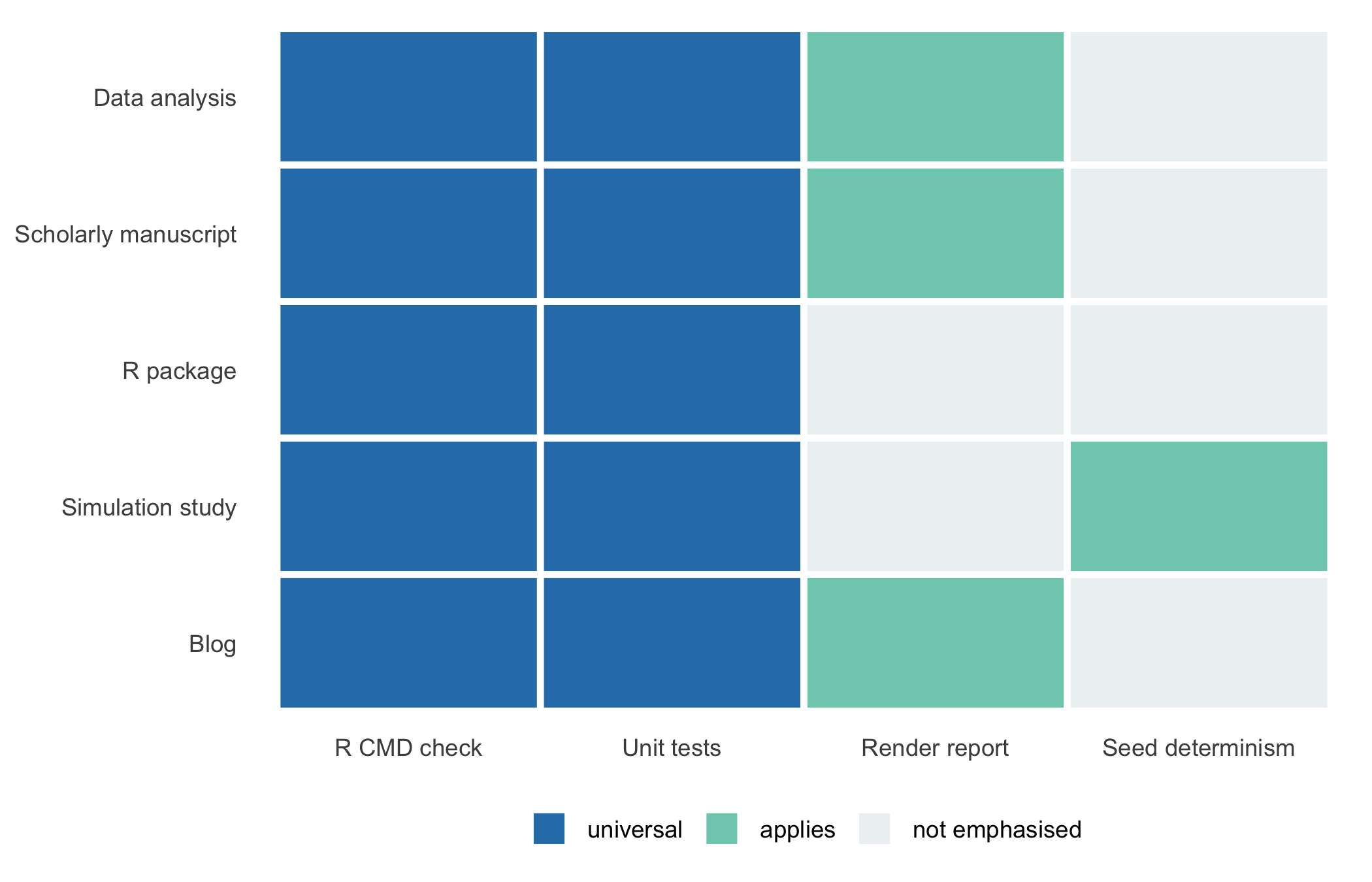
The five archetypes and their differences are summarised in Table 4.1, and Figure 4.1 shows which validation gates apply to each. The reader should read both across the rows, to see how the layout and the gates vary, and down the two universal columns, to see how much stays fixed.
library(tibble)library(knitr)archetypes<-tibble::tibble( archetype =c('Data analysis', 'Scholarly manuscript', 'R package','Simulation study', 'Blog'), directory =c('analysis/scripts/, analysis/figures/','analysis/report/','R/, man/, tests/','analysis/scripts/, derived_data/','many analysis/ index.qmd posts'), report =c('Optional', 'Yes, to PDF', 'No','Optional', 'Yes, many'), gate =c('R CMD check and tests','R CMD check plus render','R CMD check and unit tests','R CMD check plus seed determinism','R CMD check plus render of each post'), example =c('Incident-diabetes cohort analysis','PTSD and diabetes comorbidity paper','Clinical-trial summary-table package','Power and operating-characteristics simulation','Teaching blog or lab notebook'))knitr::kable(archetypes, col.names =c('Archetype', 'Directory emphasis', 'Renders a report?','Primary validation gate', 'Health-sciences example'))
Table 4.1: The five research-compendium archetypes. The reproducibility machinery is identical across all five; only the directory emphasis, the presence of a rendered report, and the gates that apply on top of the universal R CMD check differ.
Figure 4.1: Validation gates by archetype. The R-package check and the unit tests apply universally; the render and seeding gates apply selectively. The underlying reproducibility machinery, the Five Pillars, is identical across every row.
NoteCheck your understanding: the render-none case
A reviewer objects that a compendium producing no rendered document cannot be a reproducible research object, since there is no result to reproduce. Which archetype answers this objection, and how?
The R-package archetype answers it. A package that exports a summary-table function has no report to render, yet it is fully reproducible: its result is the behaviour of the function, and that behaviour is protected by R CMD check and by the unit tests, which regenerate and verify the function’s outputs on every check. The absence of a render gate does not weaken reproducibility; it simply reflects that the deliverable is a tested procedure rather than a document. Reproducibility is a property of re-execution, not of rendering.
4.9 Progressive disclosure
The five archetypes are not walls between separate kinds of project. They are, rather, stages a single project may pass through, and the framework’s most useful structural property is that the same layout supports the whole trajectory without reorganisation. This is what the framework calls progressive disclosure: the same directory layout, the same Makefile, and the same Five Pillars carry a project from one archetype to the next, so that no transition demands that the analyst tear the project apart and rebuild it in a new shape.
The trajectory is easy to picture, and it is the one our epidemiology student is likely to walk. The project begins as a data analysis: scripts and figures, no manuscript. As the findings firm up, a report.Rmd is added to analysis/report/ and the project becomes a manuscript compendium, with the render gate now active, but nothing already written needs to move. In the course of the analysis a cleaning routine and a modelling helper prove useful enough to document and test, so they migrate from analysis/scripts/ into R/, and the package archetype’s gates begin to bite on them without any change to the layout. Should one of those functions reach general interest, the compendium can be shared as a package, its R/ and man/ and tests/ now first-class, while the analysis/ directory recedes to a development notebook. The same compendium has been, in turn, a data analysis, a manuscript, and a package, and at no point was it reorganised.
The lesson we draw, and it is the organising lesson of the chapter, is that the archetype is a description of a project’s current emphasis rather than a permanent category. The reproducibility machinery is invariant across the archetypes and across the transitions between them, and it is precisely this invariance that lets a project evolve without ever leaving the reproducible state it started in.
4.10 Worked example
To make the progressive-disclosure trajectory concrete, we follow a single compendium through its first two archetypes, staying at the level of the directory and the gates rather than the analysis. Suppose our student begins the incident-diabetes study. The compendium is created and its archetype recorded as a data analysis. The shell session below is illustrative and is not executed.
The student places the registry extract under raw_data/, writes analysis/scripts/01_clean.R to produce a derived cohort table, and writes analysis/scripts/02_model.R to fit the Cox model. A unit test in inst/tinytest/ asserts the cohort size and that no fitted hazard ratio is negative. At this point the only gates that apply are the universal check and the tests, run in a clean environment:
$ make check-renv # dependencies declared and locked$ make docker-test # tinytest only$ make docker-check # R CMD check
Some weeks later the results are firm enough to write up. The student adds analysis/report/report.Rmd, moving the figure code out of 02_model.R and into report chunks that regenerate the figures on render. The compendium is now a manuscript, and the archetype line in zzcollab.yaml is updated to reflect it, but not a single existing file has moved. A render gate now joins the others:
$ make docker-render # rebuild report.Rmd to PDF
The cleaning routine, meanwhile, has grown into a general helper worth documenting, so it migrates from analysis/scripts/01_clean.R into R/prepare_cohort.R, gains a roxygen2 block, and picks up its own unit tests. The package archetype’s discipline now protects it, and R CMD check verifies that the documentation matches the function signature. The same compendium is now doing the work of three archetypes at once, on one unchanged layout, with each gate applying to the part of the project that warrants it. This is progressive disclosure in operation, and it is the payoff of having chosen a single, principled container at the outset.
4.11 Collaborating with an LLM
A language model is a capable assistant for scaffolding and organising a compendium, and an unreliable one for the judgements that define it. The three triples below mark the division.
Prompt. ‘I have a folder of R scripts and CSV files for a cohort analysis. Propose a research-compendium directory structure and tell me which files go where.’
Watch for: a plausible layout that silently guesses the raw-and-derived boundary, placing a file the model cannot distinguish as input or output into the wrong directory, and an omission of the R-package skin (DESCRIPTION, NAMESPACE) that quietly forfeits the R CMD check gate.
Verification: confirm by hand that every file in raw_data/ is a genuine immutable input and every file in derived_data/ is regenerable from code, because this is the analyst’s judgement and not the model’s. Confirm the R-package skin is present, and run R CMD check to establish that the proposed structure is in fact checkable.
Prompt. ‘Which archetype should this project be, and which validation gates apply?’
Watch for: a default to the manuscript archetype, since that is the most common case in the model’s training data, even when the project has no report and is really a package or a simulation study; and a confident enumeration of gates that includes a render gate for a project that renders nothing.
Verification: decide the archetype yourself from the project’s actual deliverable, a document, a function, or a set of stored simulation results, and then check that the gates the model lists match Table 4.1 for that archetype. A render gate on a render-none package is the tell that the model has guessed the archetype wrongly.
Prompt. ‘Write the unit tests that should gate this compendium.’
Watch for: tests that assert only that functions exist or that a script runs without error, which are structural checks rather than correctness tests, and, for a simulation compendium, an absence of any test that the seeded output is reproducible.
Verification: read each generated test and confirm it checks a value the analysis actually depends on, not merely that code executes. For a simulation study, add or verify a test that a fixed seed yields identical output on a second call, since that is the property the archetype exists to protect and the one a model is most likely to omit.
4.12 Exercises
Take an existing analysis of your own, currently a scatter of scripts and data files, and classify it as one of the five archetypes. State the deliverable that determines the classification, and list the validation gates that should apply on top of R CMD check.
For that same analysis, draw the raw-and-derived boundary explicitly: list every data file and assign it to raw_data/ or derived_data/, justifying each assignment by whether the file is an immutable input or a regenerable product. Identify any file whose status is genuinely ambiguous and explain the ambiguity.
Explain, in a paragraph, why R CMD check is described in this chapter as a universal gate. What does dressing a compendium in the R-package skin buy that a plain, well-named folder does not?
Sketch a progressive-disclosure trajectory for a project that begins as a simulation study and ends as an R package. At each transition, state which gate becomes active or inactive, and confirm that no directory needs to be reorganised.
Consider a simulation compendium whose driver script contains no set.seed() call. At which rung of the reproducibility ladder can such a compendium sit at best, and why can it not, even in principle, reach L3? Write the one-line test you would add to gate the seeding.
The chapter claims that the manuscript is only one of five archetypes. Construct the strongest argument you can for the opposing view, that every serious research compendium should ultimately produce a rendered document, and then state where the argument fails.
4.13 Further reading
The foundational proposal is Gentleman and Temple Lang’s account of the compendium as an executable document combining text, code, and data (Gentleman & Temple Lang, 2007); it reads well alongside Knuth’s original statement of literate programming, from which the idea descends (Knuth, 1984). The operationalisation that this chapter builds on is Marwick, Boettiger, and Mullen’s proposal that an R package is the natural compendium container, together with their rrtools tool (Marwick et al., 2018); the reader who wants the R-package mechanics in full should consult Wickham’s book on R packages, which is the standard reference for the skin that makes R CMD check apply (Wickham, 2015). For the complementary skill of reading a compendium one has received rather than writing one, Nust, Boettiger, and Marwick offer a short and practical guide (Nüst et al., 2018). Finally, Peng’s argument that reproducibility is a minimum standard for computational science supplies the motivation that the compendium is built to serve (Peng, 2011), and the individual pillars named in this chapter are developed in 1, Chapter 6, and the validation chapters that follow.
Allaire, J. J., Teague, C., Scheidegger, C., Xie, Y., & Dervieux, C. (2024). Quarto: An open-source scientific and technical publishing system. https://quarto.org/
Gentleman, R., & Temple Lang, D. (2007). Statistical analyses and reproducible research. Journal of Computational and Graphical Statistics, 16(1), 1–23. https://doi.org/10.1198/106186007X178663
Marwick, B., Boettiger, C., & Mullen, L. (2018). Packaging data analytical work reproducibly using R (and friends). The American Statistician, 72(1), 80–88. https://doi.org/10.1080/00031305.2017.1375986
Nüst, D., Boettiger, C., & Marwick, B. (2018). How to read a research compendium. arXiv Preprint arXiv:1806.09525. https://arxiv.org/abs/1806.09525